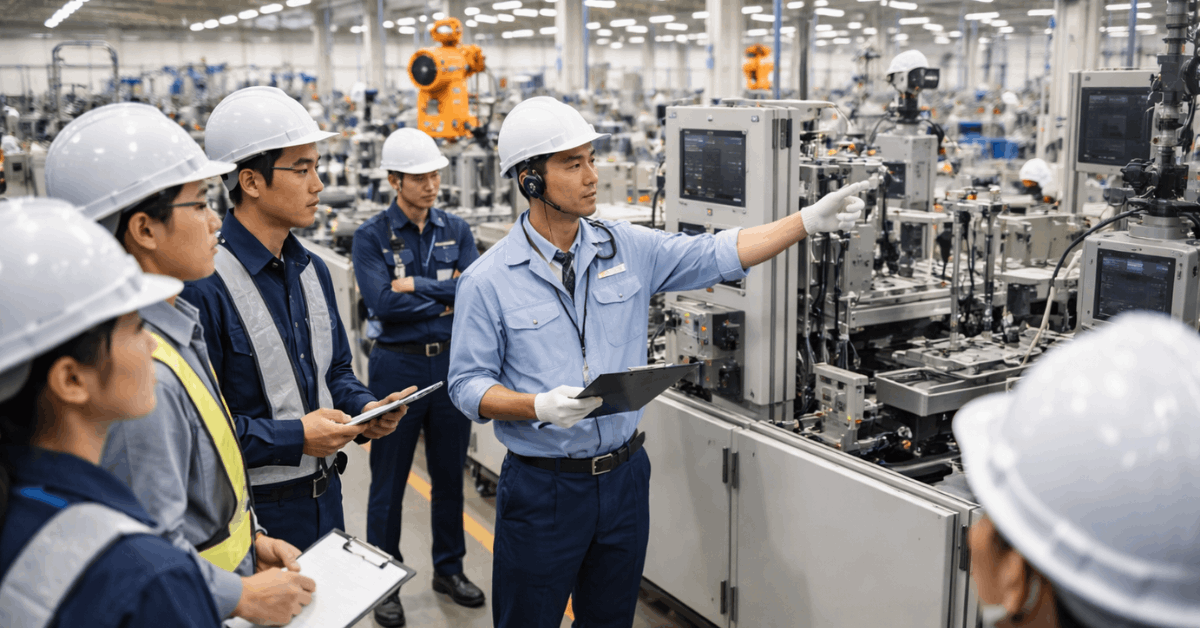
Japan’s manufacturing sector continues to face a persistent labor shortage, which means factory jobs remain one of the most accessible entry points for foreign workers seeking structured employment, steady income, and a clear path to long-term residency. You don’t need advanced qualifications to start — most entry-level roles are built around training you on the job.
This guide walks through how factory work in Japan actually functions, what it pays in 2026, which visas apply, and how to prepare a strong application.
Understanding Factory Work in Japan
Japanese factories operate on strict systems and measurable production targets. Workers are expected to follow instructions precisely, maintain consistent output, and adapt to the rhythm of the production line rather than work independently.
What Entry-Level Roles Actually Involve
Entry-level positions exist to support the production line, and the tasks are usually repetitive but essential to the process:
- Basic machine operation and assistance with product assembly
- Visual and manual quality inspection
- Packaging, labeling, and sorting finished goods
- Warehouse support and inventory movement
Tasks are timed and structured. In the first few months, accuracy matters more than speed — supervisors are watching for consistency before they hand you more responsibility.
Industries That Hire Entry-Level Workers
Your daily duties will look very different depending on which sector you join.
- Automotive plants – parts assembly and inspection
- Electronics manufacturers – precision handling of small components
- Food processing facilities – strict hygiene and sanitation protocols
- Semiconductor plants – cleanroom discipline and protective clothing
- Plastics and metal fabrication – heavier materials and physical stamina
Each sector runs its own structured onboarding, but the core expectation — discipline and repeatable accuracy — stays the same across all of them.
Types of Employment Contracts
Understanding your contract type before you sign is essential, since it directly affects your income stability and legal protections.
Full-Time Permanent Employment
This is the most stable option. You receive a fixed monthly salary, typically with a bonus (shōyo) paid twice a year in summer and winter. Full-time staff are enrolled in health insurance and pension coverage, and paid leave increases with years of service. Promotion into senior or supervisory roles becomes realistic with time and reliability.
Contract and Dispatch Work
Many factories staff their lines through dispatch (haken) agencies rather than hiring directly. Common structures include:
- Fixed-term contracts running 3 to 12 months
- Placement through a staffing agency rather than the factory itself
- Renewal based on performance and production needs
- Hourly wages instead of a fixed monthly salary
Dispatch work can pay a higher hourly rate and offers more flexibility, but long-term job security is weaker than permanent employment. Always review the renewal terms before accepting.
Part-Time and Shift-Based Roles
These suit students, working holiday visa holders, or anyone not looking for full-time commitment. Pay is entirely dependent on hours worked, shifts can be day, night, or rotating, and Japanese labor law requires overtime and night-shift premiums to be paid on top of the base rate.
Salary Expectations and Benefits in 2026
Pay varies by prefecture, industry, and contract type, so it’s worth setting realistic expectations before you apply.
Wages and Pay Structure
As of 2026, every one of Japan’s 47 prefectures has a minimum wage above ¥1,000 per hour, with the national average sitting around ¥1,120 per hour. Tokyo and other major urban centers pay closer to ¥1,200+ per hour, while rural prefectures sit nearer the ¥1,000–1,050 range. On a standard full-time schedule, that works out to roughly ¥190,000–¥240,000 per month before overtime — figures that align closely with the ¥180,000–¥250,000 range factories have historically quoted for entry-level roles.
The government has also committed to raising the national average minimum wage toward ¥1,500 per hour by the late 2020s, so entry-level pay is expected to keep climbing over the next several years. Overtime is paid on top of standard hours, and night shifts typically carry an additional premium.
Common Employee Benefits
- Health insurance coverage
- Pension (kōsei nenkin) contributions
- Commuting/transportation allowance
- Company dormitory options in many manufacturing regions
- Paid annual leave, usually expanding after a probation period
Dormitories in particular make a real difference to take-home pay, since they cut housing costs — often one of the largest expenses for a new arrival — dramatically.
Work Environment and Daily Structure
Shift Patterns
Most factories run one of three shift structures:
- Day shift – standard business hours
- Night shift – comes with additional pay
- Rotating shift – schedule changes every few weeks
Whichever pattern you’re assigned, punctuality is treated as non-negotiable.
Workplace Culture
Japanese factory floors run on discipline, hierarchy, and clear procedure. Cleanliness in production areas is mandatory, safety briefings are taken seriously, and communication tends to be direct but not elaborate. Supervisors track attendance and task completion closely, and cooperating smoothly with coworkers matters as much as individual output.
Requirements and Qualifications
Basic Eligibility
You generally don’t need a university degree. What factories actually prioritize:
- At least a high school diploma
- Basic conversational Japanese
- Physical fitness to handle long or rotating shifts
- The ability to follow instructions with minimal supervision
- Legal eligibility to work in Japan
Documents to Prepare
- A valid work visa
- Residence card (zairyu card)
- Identification documents
- A Japanese-format resume (rirekisho)
Accurate, correctly formatted paperwork speeds up hiring significantly — employers are legally required to verify your work status before you start.
Visa and Legal Work Options in 2026
Japan’s system for foreign manufacturing labor is in the middle of a major overhaul, so it’s worth understanding exactly where things stand right now rather than relying on older guides.
The Technical Intern Training Program Is Being Phased Out
The Technical Intern Training Program (TITP), long the main entry route for factory trainees, is being replaced by a new Employment for Skill Development program, known in Japanese as Ikusei Shūrō (育成就労). The replacement law passed the Diet in June 2024, and the new system is set to fully launch on April 1, 2027. Throughout 2026, both systems effectively coexist: existing TITP participants can continue under the old rules for a transition period, while supervising organizations begin applying for licenses under the new framework starting in mid-2026.
Compared to TITP, Ikusei Shūrō is designed to give workers real job-change rights within their sector after roughly a year, and it’s built explicitly as a feeder into the Specified Skilled Worker visa rather than a temporary “training” arrangement.
Specified Skilled Worker (SSW) Visa
The SSW visa remains the main route for workers who want more stability and mobility than the old intern programs offered. It requires passing a skills exam and a Japanese language test, and as of 2026 it now covers 16 industrial sectors, including food and beverage manufacturing, industrial machinery, electronics, and construction. SSW holders generally have more freedom to change employers within their sector than TITP participants ever did.
Other Options
- Permanent Resident status – fewer restrictions on the type of work you can take
- Spouse visa with work permission – available to spouses of Japanese nationals or existing residents
Whichever category applies to you, immigration compliance is strictly enforced, and only registered, government-approved sending and supervising organizations should be used when applying through an agency.
Training and Career Development
Initial Onboarding
New hires go through orientation covering safety procedures, emergency drills, and equipment handling before being assigned to a line. Supervisors monitor performance closely during this period, and quality standards are explained in detail. Training can run from a few days to several weeks, and completing it is mandatory before you’re given a full workload.
Long-Term Growth
Factory work does offer a real career ladder for workers who stay consistent:
- Line worker → senior operator → team leader
- Supervisory roles that require stronger communication skills
- Certifications that improve promotion chances
- Steady attendance as the single biggest factor in advancement
Common Challenges
Factory work is demanding, and it’s worth going in with realistic expectations:
- Repetitive tasks that require sustained mental focus
- Long standing hours that demand physical stamina
- Shift changes that disrupt sleep cycles, especially on rotating schedules
- Language barriers that can slow down communication with supervisors and coworkers
Adaptability is the single biggest factor in whether new workers stick with the job past the first few months.
Living in Japan as a Factory Worker
Managing Cost of Living
Relocating requires financial planning. Urban areas cost noticeably more than rural manufacturing towns, so budget carefully for:
- Rent and utilities
- Transportation, which depends heavily on commute distance
- Food, which varies with lifestyle and cooking habits
- Mandatory health insurance deductions
Company dormitories, where offered, meaningfully reduce housing costs and are one of the biggest practical advantages of factory employment for new arrivals.
Conclusion: Building Stability Through Factory Work
Factory jobs in Japan still offer one of the clearest, most structured paths into stable employment and residency — even as the visa system around them shifts. Success comes down to reliability, adaptability, and respect for the systems you’re working within. With the right preparation, an accurate understanding of your visa options, and realistic salary expectations, factory work remains a solid foundation for building a longer-term future in Japan.